

What Is CTEM?
Continuous Threat Exposure Management (CTEM) is a continuous, five-stage program for finding, prioritizing, validating, and reducing the security weaknesses that pose real risk to an organization. Devised by Gartner, CTEM functions as an approach for assessing exposure and exploitability and aligning security work with business priorities. [1, 5]
Put simply, CTEM is a structured way to answer one question: where are we actually exposed, and which fixes should be prioritized first?
Three ideas are built into that definition:
- It's continuous: a repeating loop, not an annual audit. Threats don't care if you scan once, twice, or quarterly. They are continuously prevalent and should be treated as such.
- It's about exposure, not just vulnerabilities. That means anything an attacker could exploit, from software flaws to misconfigurations to weak identities and the attack paths that link those weaknesses to valuable assets.
- It's grounded in real risk: what attackers could exploit in your environment and the business impact that could follow, rather than a generic severity score.
To see why that matters, it helps to start with the problem CTEM was built to solve.
The Problem It Solves
Tell me if this story sounds familiar: a critical vulnerability drops; everyone scrambles to patch it, and the moment the dust settles, another one lands. The scanner can produce thousands of findings a week. You patch as fast as you can and still fall behind. And when leadership asks, "Are we actually safer than we were last quarter?" they get a chart of patched vulnerabilities, without clear evidence of reduced risk.
CTEM exists to break that treadmill. The first thing to understand is what kind of program it is.
CTEM Is Not a Product
Buying a platform does not establish a CTEM program. Vendors provide tools and services that support it, but CTEM itself is a repeatable program that combines people, processes, and technology to reduce exposure.
Plenty of tools support CTEM; the companion article explores those capabilities in more detail. But the framework itself is a process, not software. Confusing the two can leave organizations with a new platform and dashboard but the same vulnerability workflow and unanswered risk questions.
From Technical Weaknesses to Business Risk
A scanner-led vulnerability workflow often asks: "What's broken?" It then produces a long list of technical problems, commonly ranked by severity. Mature vulnerability management already considers risk; CTEM builds on that foundation with broader exposure coverage, validation, and business ownership.
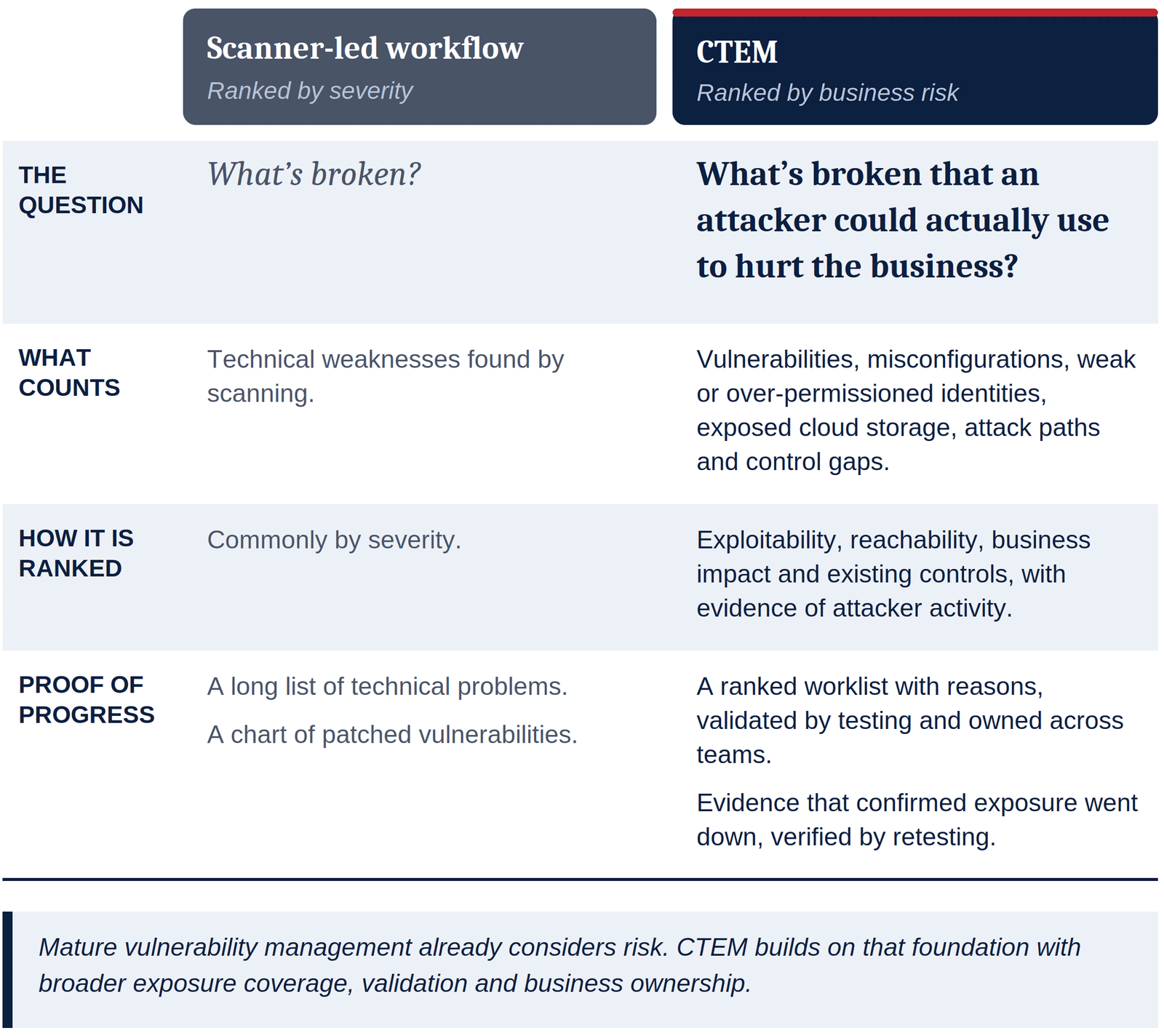
A scan finding may represent a real weakness while being unreachable from a particular attack route or blocked by an existing control. Other findings may connect to a path to sensitive data or a critical service. CTEM helps teams distinguish these situations and focus limited hours on the exposures with the greatest business impact. Lower-priority findings are tracked and reassessed as conditions change.
It also widens the lens. "Exposure" in CTEM isn't just software vulnerabilities tracked by Common Vulnerabilities and Exposures (CVE) identifiers. It includes misconfigurations, weak or over-permissioned identities, exposed cloud storage, attack paths that chain weaknesses into a route to sensitive data or critical systems, and gaps in your security controls. Attackers don't respect the boundaries between "a vulnerability" and "a misconfiguration." Rather, they exploit whatever gets them to their goal. CTEM is built to think the same way.
The Five Stages in Plain Language
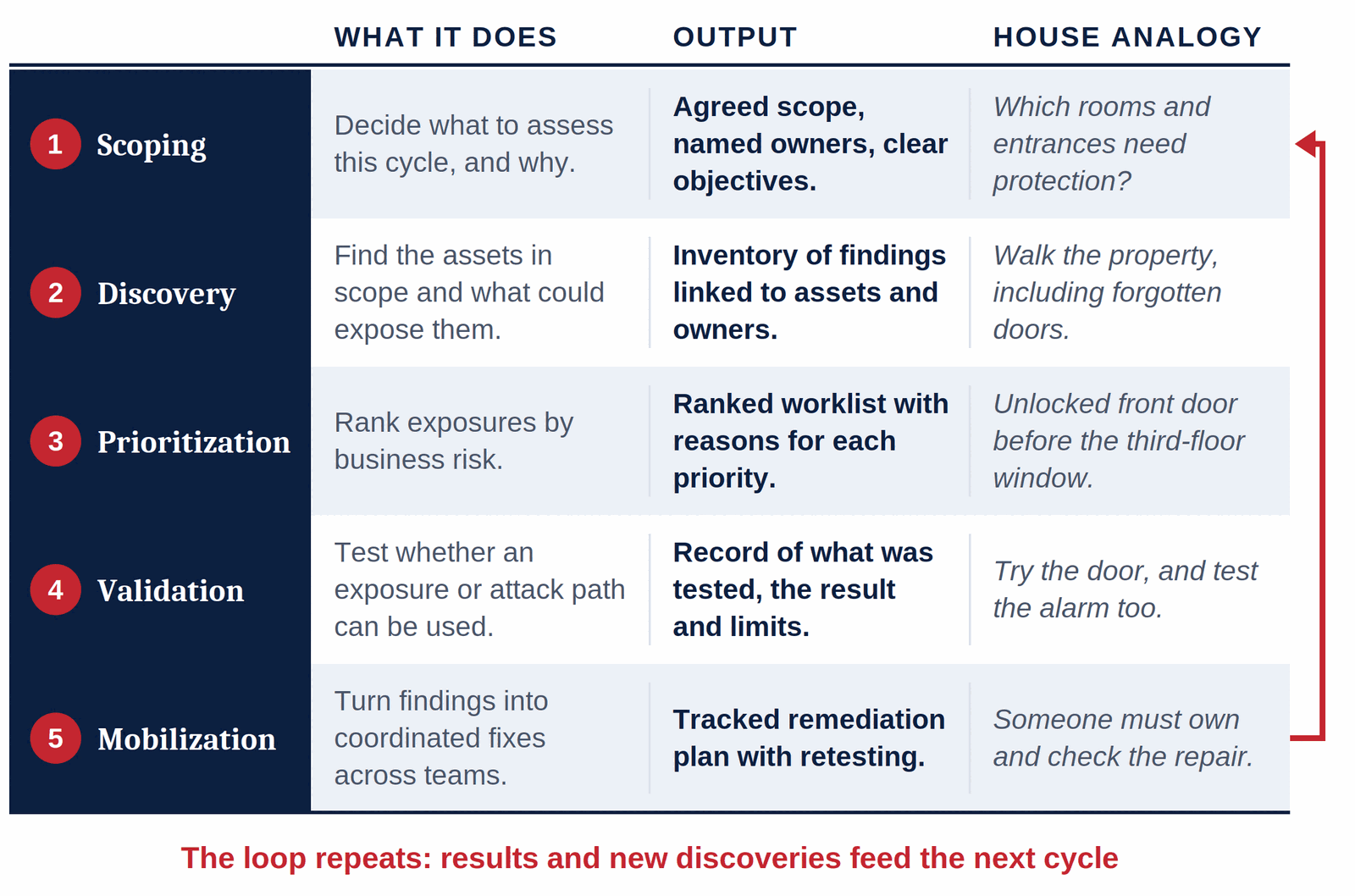
CTEM runs as a repeating loop of scoping, discovery, prioritization, validation, and mobilization. Each stage has a distinct job and practical output. The following illustrative customer-portal example shows how those stages connect:
1. Scoping
Scoping defines which business services, assets, identities, and threat scenarios the CTEM program will assess in each cycle, and why they matter. Security teams and business owners agree on priorities, boundaries, and dependencies, so the work addresses meaningful business risks.
Consider a customer portal: a website where customers sign in to access their accounts, information, or services. Its scope might include cloud hosting, customer data, administrator accounts, and connected services. The output is an agreed scope with named owners and clear objectives. Securing a house starts with a similar decision: which rooms and valuables need protection, and which entrances could put them at risk?
2. Discovery
Discovery identifies the assets within that scope and the weaknesses or conditions that could expose them to attack. It combines inventories, scanning, configuration and identity reviews, and other available evidence to build a current picture of assets, relationships, and exposures.
For the customer portal, discovery could reveal an untracked test server, an overly permissive service account, or exposed cloud storage. The output is an inventory of findings linked to affected assets and owners, including gaps that need investigation. Walking around a property serves a similar purpose: you note doors, windows, and ladders, including the ones you forgot existed.
3. Prioritization
Prioritization ranks exposures by the risk they pose to the business, so teams can decide what to address first. It combines exploitability, reachability, business impact, and existing controls with evidence of attacker activity; a severity score alone cannot capture all that context. [2]
A reachable weakness on the customer portal may warrant attention before a higher-severity finding on an isolated test system. For software vulnerabilities, FIRST's Exploit Prediction Scoring System (EPSS) estimates the chance of exploitation in the wild over the next 30 days. It does not predict compromise of your particular environment. [3] The output is a ranked worklist with reasons for each priority. An unlocked front door on a busy street may deserve attention before an inaccessible third-floor window; prioritization applies that same attention to context.
4. Validation
Validation uses targeted testing and supporting evidence to check whether a prioritized exposure or attack path can be used under defined conditions, and how security controls respond. Techniques include penetration testing, breach and attack simulation, and adversary emulation, each with different coverage and limits.
For the customer portal, an authorized test might check whether an exposed account can reach customer data and whether defenses prevent or detect that activity. The output records what was tested, the result, and any limits or gaps in coverage. When you install a lock, you try the door to check that it works; if there is an alarm, you test that too. Security validation similarly checks the exposure and the relevant controls. An unsuccessful test does not prove that every possible attack path is safe.
5. Mobilization
Mobilization turns prioritized and validated findings into coordinated risk-reduction work across security, IT, engineering, and business teams. Those teams agree on owners, actions, deadlines, and change approvals, and manage exceptions when immediate remediation is not feasible.
For the customer portal, that might mean removing excessive permissions, fixing a configuration, applying a patch, or adding a compensating control. The output is a tracked remediation or mitigation plan, with retesting to verify the result; any accepted residual risk needs an accountable owner and a review date. Finding a broken door does not repair it: someone must own the work, complete it, and check the result. Results and new discoveries feed the next cycle.
Continuous means repeating these activities at a cadence appropriate to the environment, with reassessment when assets, threats, or controls change. It does not require every stage to run in real time. Urgent exposures should trigger action between scheduled reviews; findings and fixes feed back into the next cycle.
Why CTEM Matters Now
Several pressures make a continuous approach useful:
- The perimeter has expanded. Cloud services, software as a service (SaaS), remote work, and rapid development have blurred the boundary between "inside" and "outside." Assets can now appear and disappear in seconds. Teams need to track internet-facing assets and the internal identities, permissions, and dependencies that could expose critical services.
- Exploitation now outpaces scheduled reviews. When a vulnerability is actively exploited, teams need to reassess affected assets and act without waiting for the next routine scan.
- Teams face endless alerts and competing priorities, often without a unified view of what matters most. CTEM can help teams focus effort by consolidating findings, adding business context, and testing assumptions. A valid finding can still be lower priority; that does not make it a false alarm.
Where Threat Hunting Fits
People often ask how CTEM relates to threat hunting, because both are proactive. CTEM aims to reduce exploitable exposure, while threat hunting searches for evidence of adversary activity that routine detection may have missed. These activities can run at the same time. CTEM also uses lessons from incidents and hunts to improve future assessments.
They can feed each other. CTEM's validation stage can reveal detection gaps in the scenarios tested, giving hunters hypotheses to investigate and engineers opportunities to improve coverage. When hunters find something new, such as an unknown asset or a novel technique, that intelligence flows back to sharpen CTEM's scope. Teams can use MITRE ATT&CK, a knowledge base of adversary tactics and techniques, to describe tested behavior and share context. ATT&CK is useful for that coordination, but it is not a prerequisite for CTEM. [4]
Measuring Exposure Reduction
Activity Does Not Always Translate to a Reduction in Risk
If there's one pitfall to avoid, it's reporting activity as if it were progress. "We ran 400 scans and patched 9,000 vulnerabilities" shows activity but does not by itself establish how much risk was reduced.
A CTEM program measures outcomes: how much has confirmed, exploitable exposure gone down over time? How many attack paths to critical assets have you eliminated? When you remediate something, does a retest confirm it is closed under the conditions tested? These questions give leadership a basis for evaluating progress: "We reduced the ways an attacker could reach our most critical systems by this much this quarter. Here is the evidence."
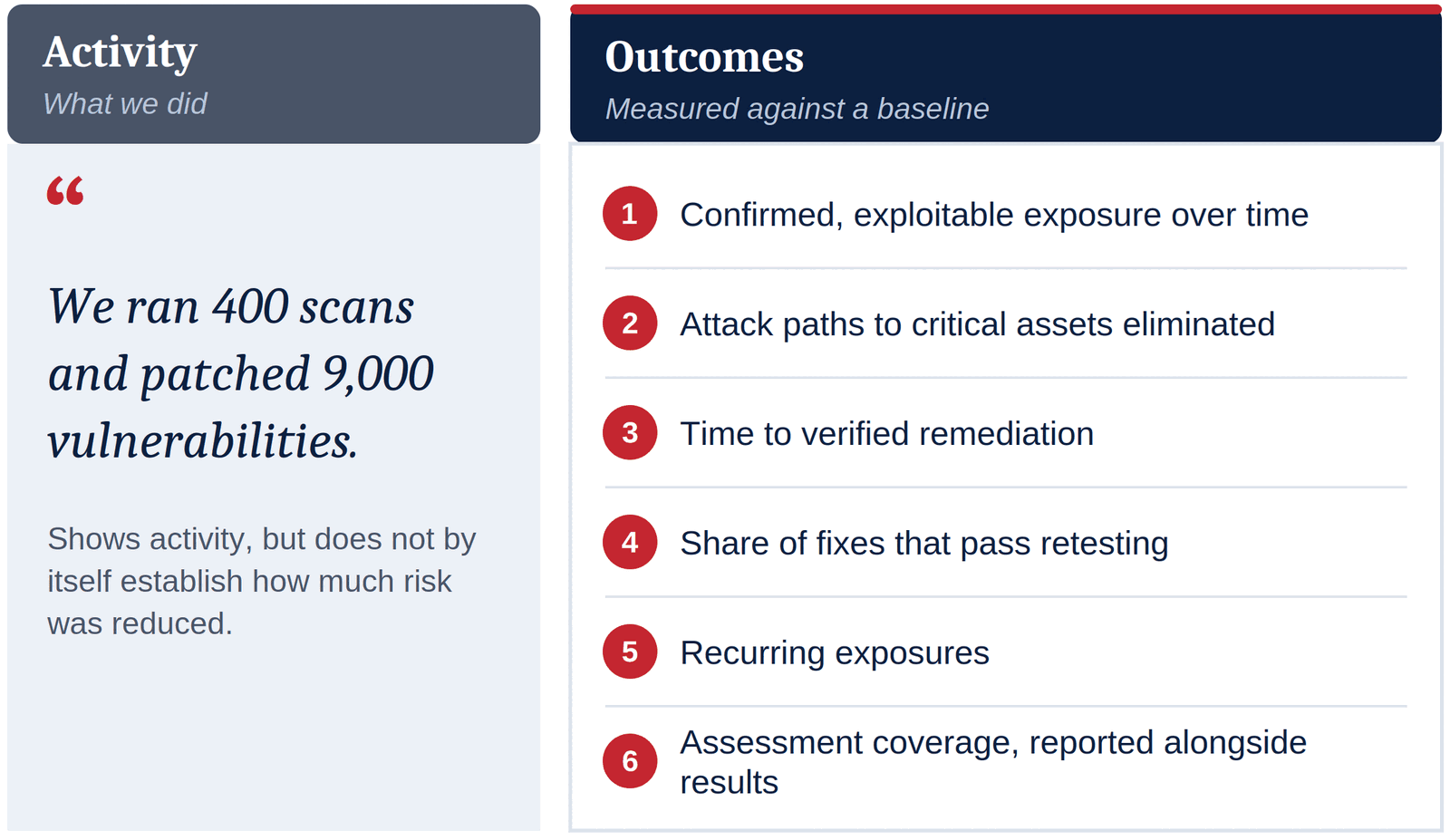
Measure change against a baseline for a consistent scope and report on assessment coverage alongside the results. A lower finding count caused by missing assets or reduced testing is not evidence of improvement. Track the time to verified remediation, the share of fixes that pass retesting, and recurring exposures as well as the remaining attack paths.
That's the difference between saying you're busy and showing you've made the business safer.
Getting Started
A practical way to begin is to start small. Pick one or two crown jewel systems: the systems that matter most to the business. Include their relevant identities and dependencies and run the full five-stage loop. Set a target for the pilot, such as ninety days, to demonstrate a measurable improvement; the timing will depend on access, staffing, and change constraints. Use the tools you already own. Don't buy a platform before you understand your own workflow. Show the early win, build momentum, and expand scope in the next cycle.
Trying to scope everything at once can delay useful results and stretch ownership across too many teams. The teams that succeed treat CTEM as a continuous operating model, with each cycle informing the next.
What Next?
Understanding the framework is step one. The natural next question is how to operationalize it: which capabilities power each stage, where to invest first, and how a platform fits into the loop without trying to "be" your whole program. That's the subject of the companion piece, How ThreatWell Powers the CTEM Lifecycle, which maps the five stages to real capabilities, shows where an offense-informed platform earns its keep, and traces how to move a program up the maturity curve.
Key Terms
- CTEM: Continuous Threat Exposure Management, a five-stage program for continuously reducing real, business-relevant exposure.
- Exposure: anything an attacker could exploit, including vulnerabilities, misconfigurations, weak identities, attack paths, and control gaps; it is not limited to CVEs.
- Attack path: a route an attacker could follow through access relationships and weaknesses to reach a target asset; the individual steps need not all involve software vulnerabilities.
- Validation: testing and collecting evidence about exploitability and control effectiveness under defined conditions, with coverage and limitations recorded.
- Crown jewels: the assets that matter most to the business; the anchor for scoping.
Sources and Further Reading
The following primary sources support the framework overview, prioritization guidance, and shared terminology used in this article.
A note on the often-quoted breach statistic: in October 2023, Gartner predicted a two-thirds reduction in breaches by 2026 for organizations prioritizing security investments through a CTEM program. [1] That statement is a forecast, not evidence that a particular organization will achieve that result. Program performance should be measured against its own baseline.
- Gartner. Gartner Identifies the Top 10 Strategic Technology Trends for 2024. October 16, 2023. See the Continuous Threat Exposure Management section.
- FIRST. CVSS v4.0 User Guide. See the discussion of CVSS Base severity and risk.
- FIRST. Exploit Prediction Scoring System. Model scope, exploitation probability, and the 30-day prediction window.
- MITRE. MITRE ATT&CK. Adversary tactics and techniques for shared analysis and testing context.
- Gartner. What We Do and How We Got Here. Company overview and business and technology guidance.