

Security testing gives an organization a controlled way to find out whether someone could exploit a weakness in its applications or systems. However, for the security operations center (SOC), the team that monitors and investigates possible threats, the test creates another opportunity: checking whether its security tools and analysts would detect the attempted attack.
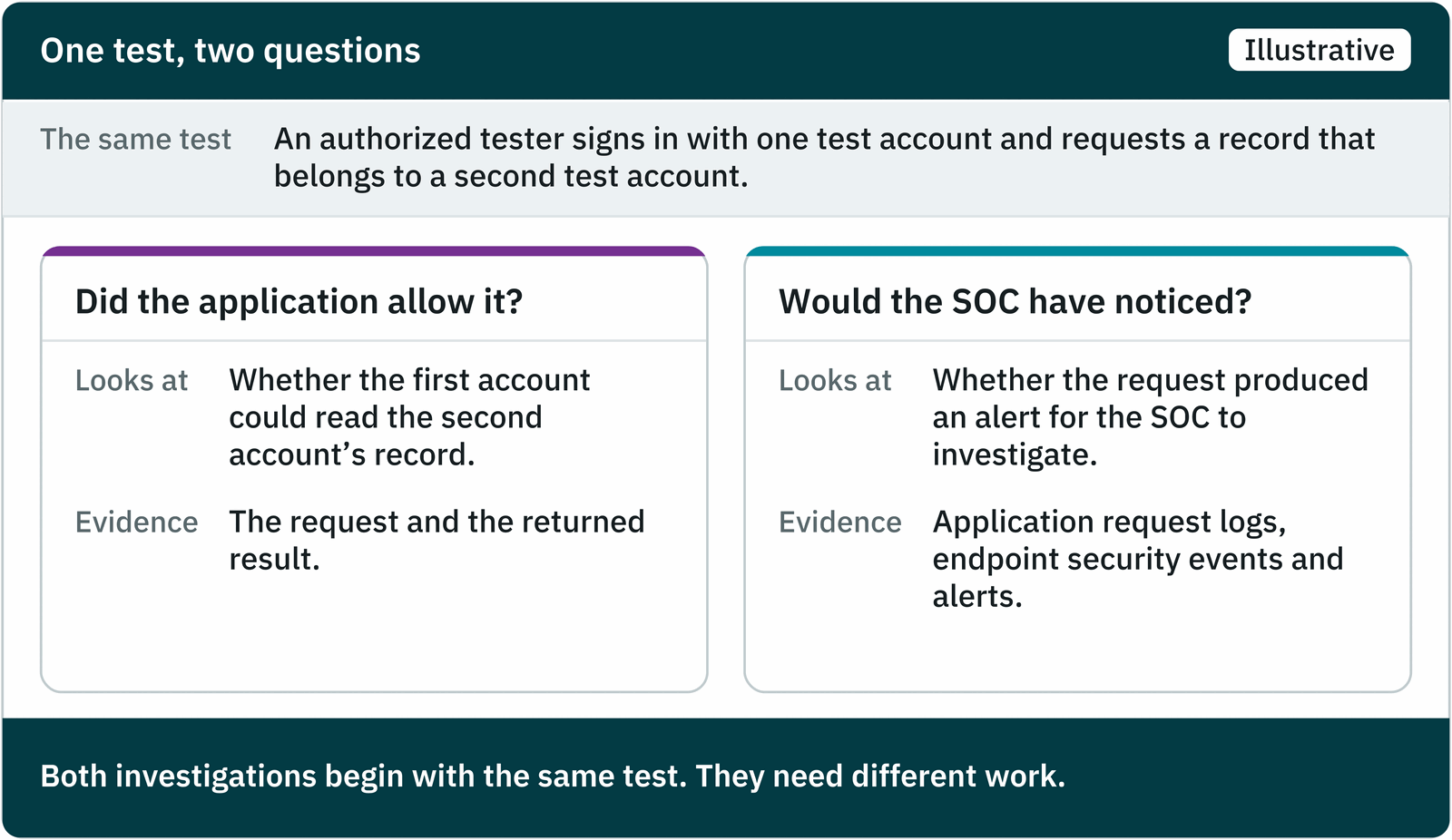
These are two different questions. An application might allow an account to read information it should not have access to. The application might also record that request without sending an alert to the SOC. Fixing the access problem and finding out why no alert arrived require different work, even though both investigations begin with the same test.
This article explores how SOC teams can use evidence from ThreatWell Command by ADCL_ to investigate a missing alert. It follows an illustrative test that simulates an unauthorized request through the application's response, the SOC's review, and the checks needed after a fix. The practical aim is to give analysts a specific action to investigate and a clear way to establish what improved.
What ThreatWell Does
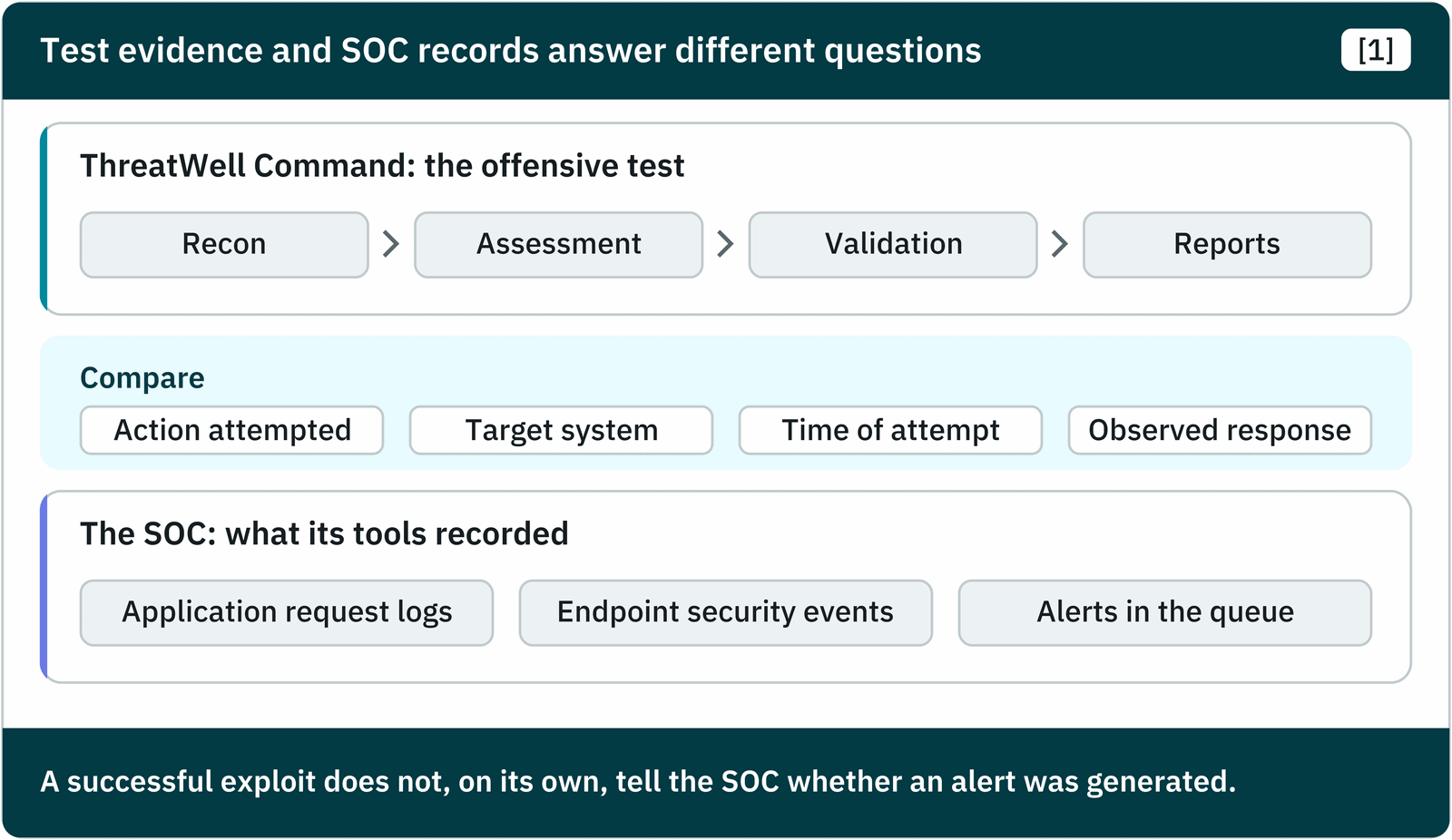
ThreatWell is software for conducting offensive security testing: authorized attempts to discover weaknesses and determine whether they can be exploited. ThreatWell Command is the product line that tests running systems. It supports Recon to discover targets, Assessment to examine possible weaknesses, Validation to test whether those weaknesses can be exploited, and Reports on the results. [1]
ThreatWell Command supports AI-orchestrated validation runs, live execution monitoring, and capture of evidence from a demonstrated compromise. [1] That evidence concerns the offensive test. SOC analysts then compare the tested action with records from the systems they monitor, such as application request logs, endpoint security events, and alerts delivered to their investigation queue.
The distinction matters because a successful exploit does not, on its own, tell the SOC whether an alert was generated. The testing team and SOC need to compare their records to answer that question. A useful review starts with the action attempted, the target system, the time of the attempt, and the observed response.
An Unauthorized Request Gives the SOC Something Specific to Investigate
Consider a test application containing fictional customer records. Each customer account should be able to read only its own records. In this illustrative exercise, an authorized tester signs in with one test account and attempts to retrieve a record assigned to a second test account. This is an example of the review process, not a reported customer result or a verified ThreatWell demonstration.
Before the exercise, the teams agree on the permitted scope and the result they expect. The application should refuse access to the second account's record. For this example, they also agree that the test behavior should generate an alert for the SOC. Planning the exercise and defining how findings will be analyzed is consistent with the assessment approach described in NIST SP 800-115. [2]
Suppose the application returns the second account's record. The tester has demonstrated an access-control weakness (broken access control, listed as A01:2021 in the OWASP Top 10 [3]): the application allowed one account to read another account's information. The testing team preserves enough evidence to explain the request and the returned result without exposing real customer data.
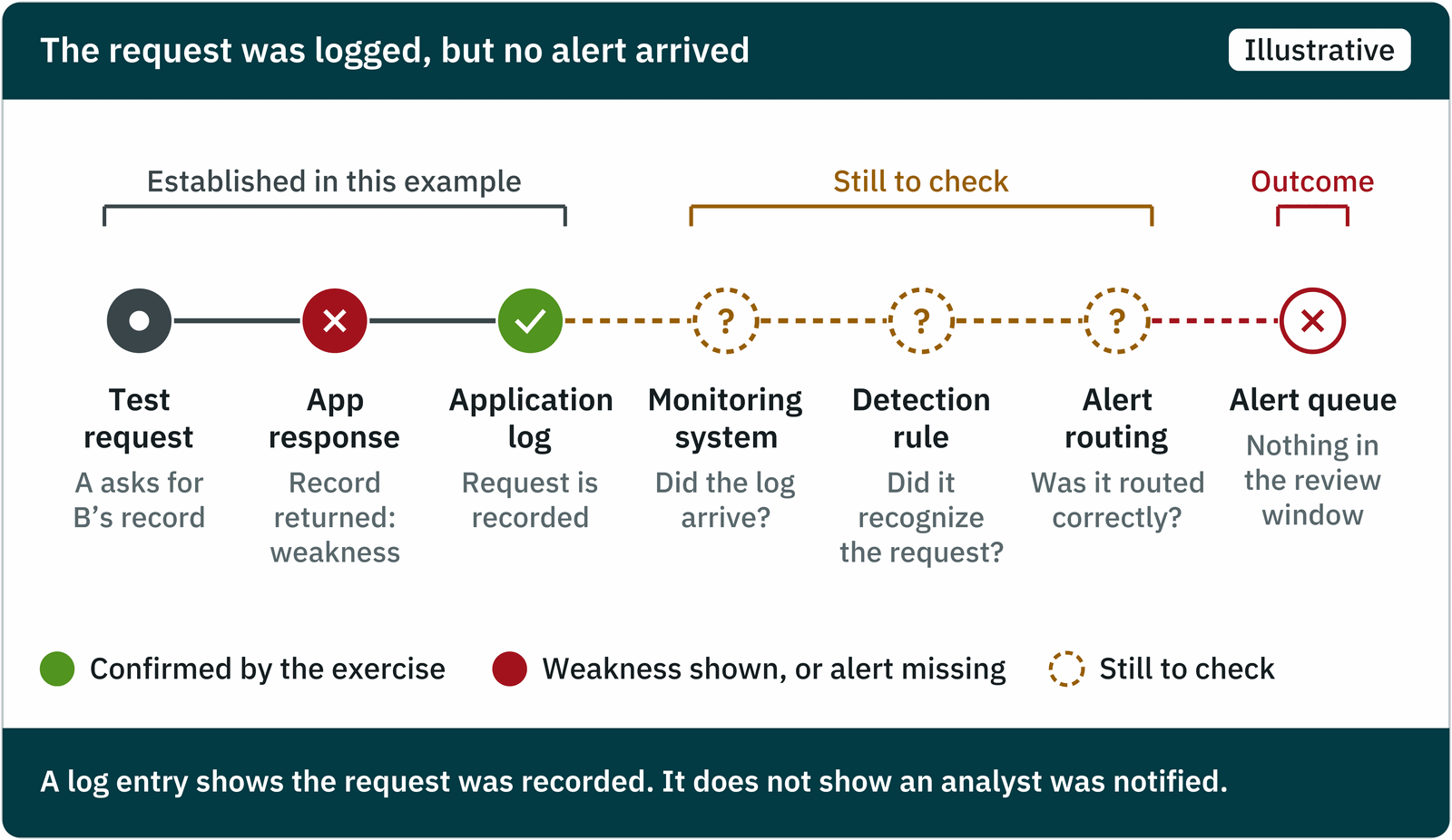
The SOC now has a concrete event to investigate. Analysts look for the request in the application logs using the test account, requested record, and time of the attempt. They then check whether an alert for that request reached their security monitoring system and investigation queue.
In this example, the application log contains the request, but the expected alert does not arrive within the agreed review window. That narrows the next investigation. Analysts can check whether the log reached the monitoring system, whether the detection rule recognized the request, and whether an alert was routed correctly. A log entry proves that the application recorded the request; it does not prove that an analyst was notified.
The Access Problem and Missing Alert Need Separate Owners
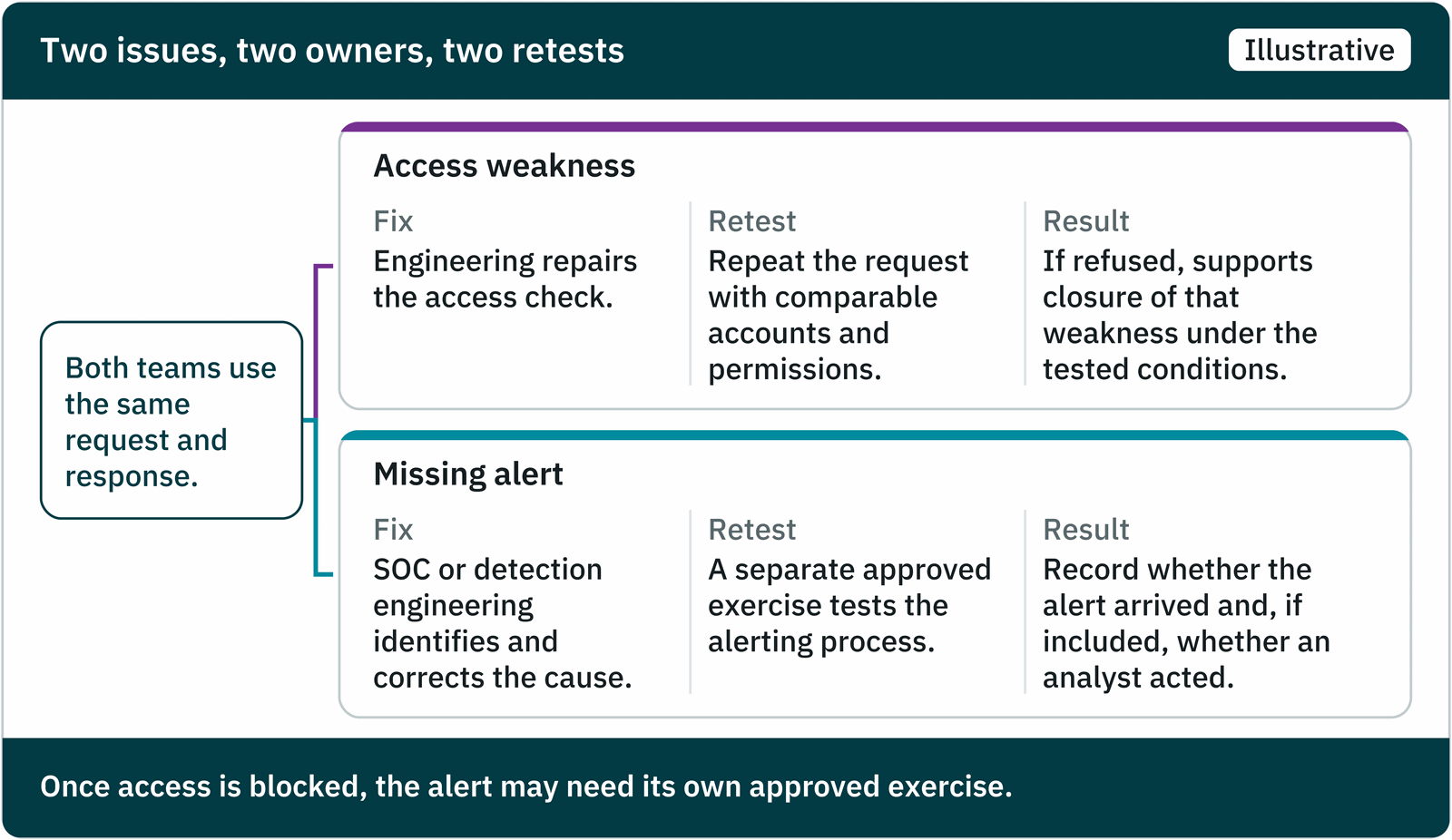
The exercise has identified two issues. Engineering needs to repair the access control weakness. The SOC or detection engineering team needs to determine why the expected alert was absent. Both teams can refer to the same request and response, while recording their own investigation and corrective action.
This shared reference can reduce repeated explanations during the handoff. Engineering can see which account accessed which records. The detection team can identify the exact request it is expected to recognize. Neither team must begin with vague instructions to investigate suspicious activity.
The fixes are different. An alert can notify the SOC about unauthorized access, but it does not necessarily prevent the application from returning the record. An application fix can deny the request, but it does not establish that the alerting process works. Keeping both issues visible helps the SOC manager explain what has been corrected and what remains unresolved.
A Retest Checks Whether the Fix Worked
After engineering changes the access checks, the tester repeats the request with comparable accounts, permissions, and application settings. If the application now refuses to return the other account's record, the retest supports closure of that specific weakness under the tested conditions. The original response and the new response provide a clear before-and-after comparison.
The alerting issue needs a separate check. Once the application blocks the request, the successful unauthorized access that the original rule was intended to recognize may no longer occur. The teams may need a separate approved exercise to test that rule. They should record whether the expected alert arrived and, if a response exercise is included, whether an analyst investigated and took the expected action.
The same exercise can be repeated. ThreatWell Command supports scheduled or continuous offensive testing. [1] Teams can use that capability as part of a testing schedule suited to the application's risk and operational constraints, with additional tests after relevant changes. For the SOC, repetition is useful when it helps confirm that application fixes and detection changes continue to behave as expected within the scope tested.
What a Small Initial Exercise Can Tell the Manager
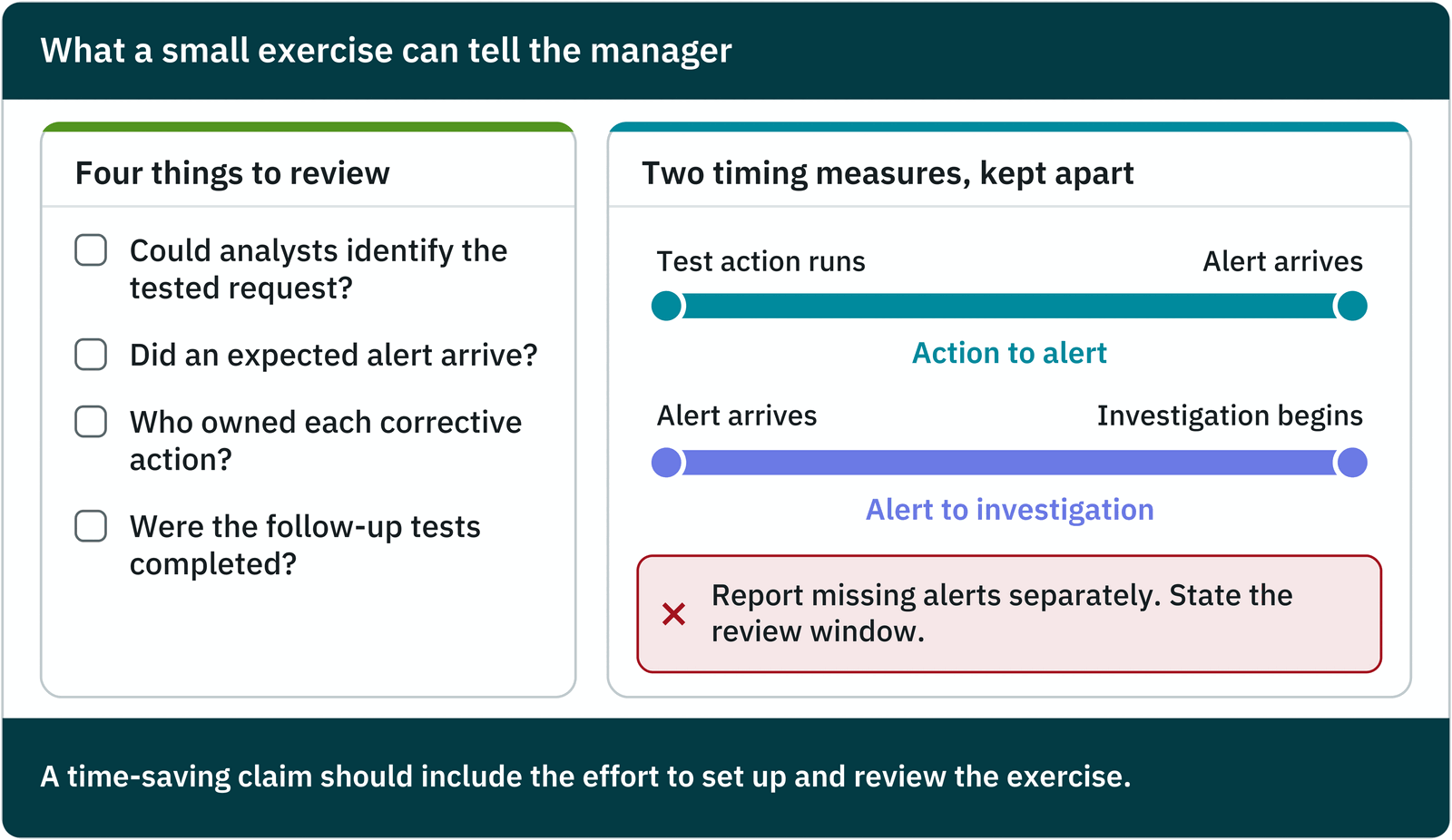
An initial, limited exercise on one approved application can help the SOC decide whether this approach is useful before expanding it. The manager can review whether analysts could identify the tested request, whether an expected alert arrived, who owned each corrective action, and whether the follow-up tests were completed.
The team can also record the analyst time spent locating logs, investigating the missing alert, and reviewing the retest. Comparing that effort across exercises of similar scope can show whether the shared test record reduces repetitive work. Any time-saving claim should include the effort needed to set up the exercise and review its results.
For alert timing, the relevant interval begins when the specified test action runs and ends when the corresponding alert arrives. Report missing alerts separately, alongside timing results for alerts received, and state the agreed review window. A separate measure begins when the alert arrives and ends when an analyst begins investigating.
The result is an account the SOC manager can explain: an unauthorized request succeeded, the application recorded it, the expected alert was missing, and two teams received specific work to complete. After retesting, the manager can state which outcomes have been verified.
Where ThreatWell Supports That Work
ThreatWell Command's role is to supply offensive test evidence in support of that review; the SOC's investigation connects the test to its own monitoring and response process. A practical first step is one approved application and one expected alert.
ThreatWell Codex finds and verifies vulnerabilities in code and dependencies; ThreatWell Command shows which exposures in running systems can actually be exploited, with the evidence to prove it.
Learn more at adcl.io/threatwell.
Sources
The sources below support the product description, the testing approach, and the weakness category used in this article.
- ADCL. ThreatWell platform. November 1, 2026 (date reviewed). Supports the product description in this article.
- NIST. Technical Guide to Information Security Testing and Assessment, SP 800-115. September 2008. Supports the planning and analysis approach for security testing.
- OWASP. A01:2021 Broken Access Control, OWASP Top 10. 2021. Supports the weakness category named in the example.